For That One Day: The Memoirs of Mitsuo Fuchida, Commander of the Attack on Pearl Harbor by Tadanori Urabe & Douglas T Shinsato
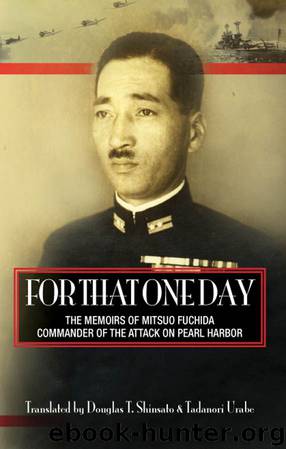
Author:Tadanori Urabe & Douglas T Shinsato [Urabe, Tadanori]
Language: eng
Format: epub
ISBN: 9780984674510
Publisher: eXperience, inc.
Published: 2012-01-09T23:00:00+00:00
32
Operation I-Go
Taking advantage of their overwhelming victory at the Battle of Midway, US forces moved aggressively against Japan at Guadalcanal. In the early morning of August 7th, 1942, they landed on Guadalcanal and Tulagi with large convoys and occupied them. The Combined Fleet’s Command Center made desperate efforts to defend the area, and they clearly understood that a wedge had been driven between the south-western Pacific and our previously undefeated territory in the Great East Asia Co-Prosperity Sphere.
Upon my discharge from the hospital at the end of October, I was assigned as an instructor to the Yokosuka Aviation Squadron, then, on December 20th, reassigned as an instructor at the Naval Academy. Although I was an instructor, there were no students to teach as they were all at the battle front. Therefore, the authorities gave me a position as Director of the Battle Lessons Research Committee. It was exactly what I wanted, and I devoted myself to the issue of battle lessons learned. Despite my eagerness, the detailed battle reports and wartime diaries from the field used to arrive almost a half-year after the events took place. Consequently, with a belief that the battle lessons should be obtained immediately from the front, I asked the authorities to prepare a Type-1 land bomber to fly me to Rabaul. I visited each airbase with a pencil and notebook hanging on my chest, walking with crutches. At the bases, they all knew me. However, when I said that I was there for research on battle lessons, they suspected that I was conducting a performance review or something similar, and they did not give me the facts. I was perplexed by their attitude.
However, this was in the midst of Operation I-Go. Operation I-Go was an aviation showdown battle surrounding the offensive and defensive battles at Guadalcanal that lasted for six months.
Admiral Yamamoto had moved his admiral’s flag from the battleship Yamato to Rabaul to command at the front. He did this with the intention of forcing a showdown in the air, concentrating the entire air power of the Imperial Japanese Navy on the battle. However, his opponent was the US Army Air Force, and instead of a showdown the battle gradually became a war of attrition. The problem then was the supply of planes and pilots, and that proved to be our weakness. In view of these conditions, Yamamoto diverted the full contingent of carrier pilots from the Third Fleet to land bases with the excuse that necessity knows no law, and he sacrificed most of them in the aerial war of attrition.
This is the kernel of my third argument that Admiral Yamamoto was a mediocre admiral.
At the time, the Japanese military was not aware yet that the US military had formed two fronts against Japan, the MacArthur Line and the Nimitz Line. They did not recognize that Guadalcanal was a precursor of the MacArthur Line, and that before long, Nimitz would begin mobilizing his task force of 10 carriers at the core and advance to strike the Mariana Islands by way of the Gilbert and Marshall Islands.
Download
This site does not store any files on its server. We only index and link to content provided by other sites. Please contact the content providers to delete copyright contents if any and email us, we'll remove relevant links or contents immediately.
| Africa | Americas |
| Arctic & Antarctica | Asia |
| Australia & Oceania | Europe |
| Middle East | Russia |
| United States | World |
| Ancient Civilizations | Military |
| Historical Study & Educational Resources |
The Radium Girls by Kate Moore(12036)
100 Deadly Skills by Clint Emerson(4932)
Rise and Kill First by Ronen Bergman(4797)
The Templars by Dan Jones(4695)
The Doomsday Machine by Daniel Ellsberg(4493)
The Rape of Nanking by Iris Chang(4224)
Killing England by Bill O'Reilly(4008)
Stalin by Stephen Kotkin(3973)
Hitler in Los Angeles by Steven J. Ross(3949)
12 Strong by Doug Stanton(3555)
Hitler's Monsters by Eric Kurlander(3352)
Blood and Sand by Alex Von Tunzelmann(3207)
The Code Book by Simon Singh(3197)
Darkest Hour by Anthony McCarten(3137)
The Art of War Visualized by Jessica Hagy(3014)
Hitler's Flying Saucers: A Guide to German Flying Discs of the Second World War by Stevens Henry(2759)
Babylon's Ark by Lawrence Anthony(2686)
The Second World Wars by Victor Davis Hanson(2529)
Tobruk by Peter Fitzsimons(2521)
